Friday, April 8, 2016

Tokyo Tower

Tokyo Tower is a famous tower in Japan. It's a traditionally very romantic spot for tourists and Japanese people alike. Tokyo Tower is an Eiffel Tower-like structure that towers over Tokyo metropolis. At night the tower lights up with a bright yellow glow that makes it quite the spectacle. The tower is originally used as a hub for communication, but the height grants a great view as well. The Japanese word for Tokyo Tower written, 東京タワー, is pronounced 'To-kyo Tah-wah.' The word タワー (tawaa) is written in katakana. Katakana is a Japanese written language that is primarily used with foreign words integrated into the language. That word comes from the English word "tower" so it's usually easy for foreigners who speak English to understand.

When I was in Japan, I met many very friendly people. One of them was named Ashimoto, and he was in basketball club. In Japan, school clubs are taken very seriously so he was always practicing very hard. When he had breaks from club and time after school, we would talk. I talked to him about many things, such as the difference between Japanese and American music, and similar pop songs we both liked. He even showed me songs popular in America that I'd never heard before. One day after class, we were talking a lot and he asked me if I knew of Tokyo Tower. Then he asked me on a date to go with him. I was very surprised, but I had to leave Japan soon so I turned him down.


[source]

Thursday, April 7, 2016

Nara

Nara is my favorite place in all of Japan. Nara is a place in Kyoto. There are restaurants, shops, and many other things just like any other normal city. However, there is one thing that sets Nara apart from other places in Japan. Wild deer live in the public parks in Nara. These deer are very tame and will allow you pet them. They have been trained to recognize their food comes from humans, and humans are friendly. You can buy a pack of 6 rice crackers for them (made specially with nutrients and ingredients deer like and need for a healthy diet) for only 150 yen. That's less than $1.50 with the current inflation rates taken into account.

Nara also has temples and a museum. There are gift shops everywhere where you can buy deer-themed everything. Deer plushies, deer wallets, deer post cards, deer washitsu (folding fans), deer keychains, deer everything. Nara has 7 temples, but I only went to one. The most popular temple in Nara is called Todai-ji. Todai-ji means the “Great Eastern Temple” and it’s one of Japan’s most significant temples.

When I went to Nara, I was so excited. I had heard about the deer before coming to Japan, and it's the place I was looking forward to going the most. The Nara deer were so friendly, however there was one buck that was very aggressive. He would use his horns to try to hit you or your hand to knock the food you were holding to the ground. He followed one person from our group all around, and even ate food right out of his lap. It was absolutely hilarious because we took pictures while this was happening. One of the pictures that was taken looks rather questionable, and it became an inside joke between us the whole trip.

I was amazed at how the deer were so calm with humans. Many people were petting the deer. Some deer sleeping close to the sidewalk were surrounded by people petting them and they hardly stirred. The deer were curious and came up to any new people. Since Nara is a popular tourist destination, there are hundreds of new people every day. Someone who hadn't been to Nara before squealed as the deer surrounded him and pushed at each other for the food he had. Many people laughed, and I was amazed. There was so much respect and trust between the deer and the people: people allowed the deer to come close too. Small children squealed as they chased the deer in packs. Slightly alarmed, the deer would trot (or run, if needed) away before the kids got too close. Parents of the children watched calmly from behind a loose wooden fence created more for an appearance of a barrier than a functional one. People all around were taking pictures of the deer, posing and quickly snapping pictures before the deer moved away or blurred the shot.

The trip to Nara was the first time I've ever touched a deer, let alone take selfies with one. The deer had very coarse fur. Each strand of hair was thick and long, so thick it was hard to bend the strands compared to normal hair. Their eyes were big and glassy, and they had long eyelashes that reminded me of cow's' eyes. Their long snouts ended in a cute purple nose, and they moved toward us eagerly awaiting food. Their hooves were dark black and layered, and their coarse fur covered their legs only to stop at the hooves. Their bushy white tails flicked back and forth as they lightly scratched the sandy ground with their hooves. Their ears twitched away flies in the Japanese summer heat. I was surprised with how big they were. I'd only seen deer from a distance as they darted in and out of woods on the side of the road. Their wide torsos expanded as they snorted expectantly for more food. They were powerful and graceful. As I watched an albino stag delicately rise from the ground and proudly parade into the sunlight, I understood why deer were sometimes revered as gods.

Saturday, April 2, 2016

Kinkakuji

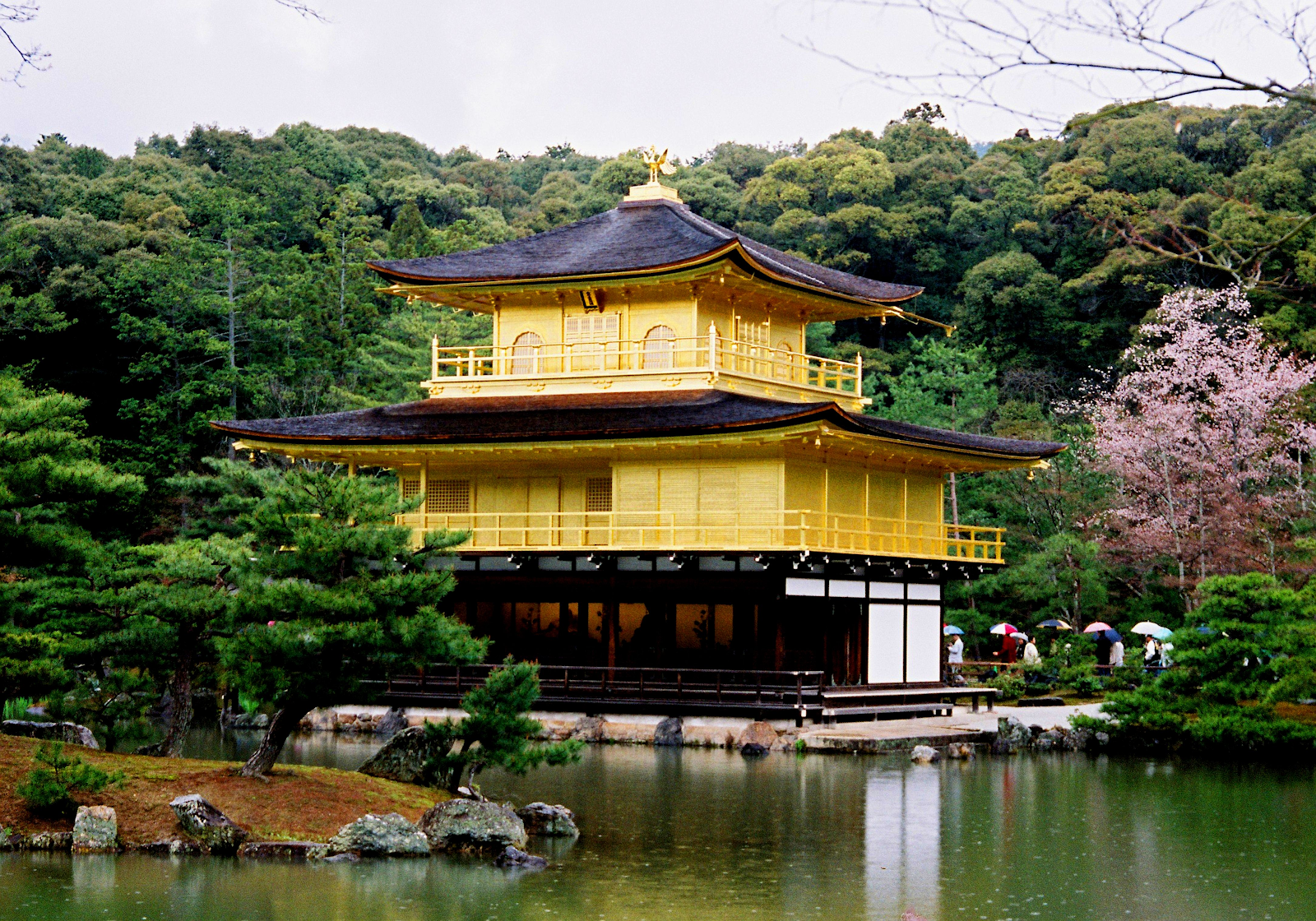
Kinkakuji (金閣寺) is a famous Japanese temple in Kyoto. The kanji for kinkakuji means “Golden Pavilion.” It was originally named Rokuonji (鹿苑寺) which means “Deer Garden Temple” Kyoto has a place called Nara in it, which is very famous for its wild deer that live among the park. The deer are tame and you can pet them, among other things. Kinkakuji is a zen Buddhist temple. This temple is surrounded by water and trees. In spring, many of the Cherry Blossom trees bloom and create a gorgeous pink wall surrounding kinkakuji.


I never visited Kinkakuji but if I ever go back to Japan I’d love to go!


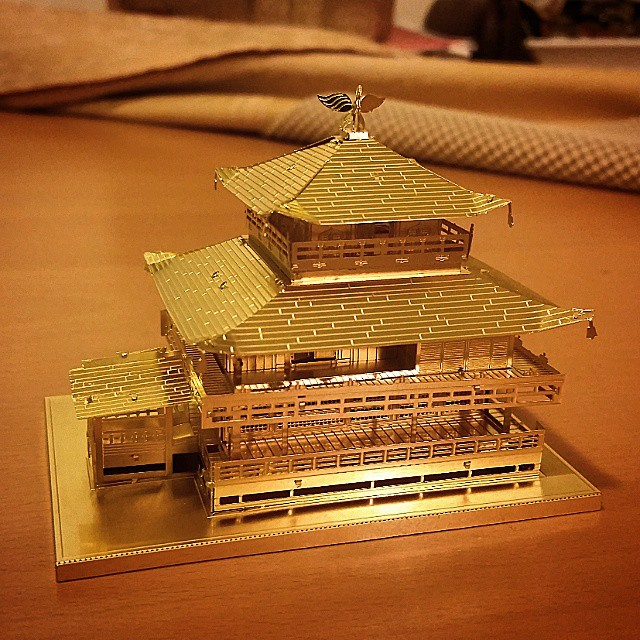
I bought a model of kinkakuji and assembled it for fun. The model was made of gold-colored metal and very small when I finished it. However, it was very detailed so it was difficult to assemble. Despite being difficult, it was fun to make!


The picture below isn’t mine, but it’s the same make and model as the one I assembled. I’m just too lazy to take a picture of the one I assembled (lol)


Friday, April 1, 2016

Nagoya

Nagoya's main industry is automotive. Many companies are based out of Nagoya. Toyota's luxury brand Lexus, Denso, Aisin Seiki Co., Toyota Industries, JTEKT and Toyota Boshoku have their headquarters in or near Nagoya. Mitsubishi Motors has an R & D division in the suburb of Okazaki. Major component suppliers such as Magna International and PPG also have a strong presence here. Spark plug maker NGK and Nippon Sharyo, known for manufacturing rolling stock including the Shinkansen are headquartered there.

The aviation history has historically been of importance since the industrialization. During the war the Mitsubishi A6M Zero fighter was constructed in Nagoya. The aviation tradition continues with Mitsubishi Aircraft Corporation headquartered in the Nagoya Airfield's terminal building in Komaki. The Mitsubishi Regional Jet (MRJ) aircraft is produced at a factory adjacent to the airport.The MRJ is a partnership between majority owner Mitsubishi Heavy Industries and Toyot with design assistance from Toyota affiliate Fuji Heavy Industries, already a manufacturer of aircraft. It is the first airliner designed and produced in Japan since the NAMC YS-11 of the 1960s. The MRJ's first flight was on November 11, 201

JR Central, which operates Tōkaidō Shinkansen, has its headquarters in Nagoya, as does the regional Meitetsu railway company.
Nagoya lies north of Ise Bay on the Nōbi Plain. The city was built on low-level plateaus to ward off floodwaters. The plain is one of the nation's most fertile areas. The Kiso River flows to the west along the city border, and the Shōnai River comes from the northeast and turns south towards the bay at Nishi Ward. The man-made Hori River was constructed as a canal in 1610. It flows from north to south, as part of the Shōnai River system. The rivers allowed for trade with the hinterland. The Tempaku River feeds from a number of smaller river in the east, flows briefly south at Nonami and then west at Ōdaka into the bay.

The city's location and its position in the centre of Japan allowed it to develop economically and politically.

Fushimi-Inari

Fushimi-inari-taisha (伏見稲荷大社) is a shrine in Kyoto, Japan. It has 5000 gates all lined up along a path. These gates date back to 711 A.D., and as a foreigner with only a 250 year old country, 1300 years old is an age I can’t even fathom.

In addition to age, these grounds are said to hold over 10,000 Torii gates. Experiencing these numerous and well-preserved gates at Fushimi Inari Shrine are like touching a piece of human history; if only we could see all that they have seen over the years.
To give a little background, a Torii gate is seen as an entrance to a sacred shrine in the Shinto religion. They mark the pathway to shrines across Asia, and I’m sure you’ve come to know them as a symbol of Japan.
What is unique about the Torii gates at Inari Fushimi, though, is their background. Each gate has been donated by a company or organization giving thanks for their prosperity and in hope of good fortune in the future. I only wished I could read all of the names engraved on each gate, but for now it remains to be beautiful artwork representing Japan’s past.
The significance of the shrines located at Fushimi Inari is to honor Inari (稲荷), the Shinto god of rice. You will also see foxes places throughout these grounds, as they are said to be messengers for Inari.

But, if you’re more interested in sightseeing than knowing the history, you can still enjoy the Fushimi Inari shrine just as much. As you enter the large main Torii gate you will see multiple shrines and neat shops for souvenirs. Then you will start to make your way up the stairs on the journey through the 10,000 Torii gates. The varying sizes and faded colors surprised me the most. Since pictures don’t do it justice, you have to see all of it for yourself in person.

While taking the long hike through the gates and up the hill, you will see even more shops for souvenirs and food. This is all leading up to the top of the hill, which overlooks beautiful Kyoto. But be warned, this trek up the mountain is longer than you expect. To get to the top and return again to the bottom would take 3-4 hours; if you don’t stop to enjoy the food, that is.

Thankfully, you don’t have to walk the entire path, though. You can enjoy as much or little as you want, then make your way back down through the gates to enjoy the scenery and Torii gates all over again.
As for the crowds, there really were none. I don’t know if it’s the fact that my definition of “crowd” has changed since moving from a town of 2,000 people in Virginia to a Japanese city of 400,000, but it really seemed very pleasant. And as usual, the Japanese visitors were just as much tourists as we were, taking pictures and standing in awe at all the history and sights the grounds had to offer. I’ve heard New Year’s day is a little more crowded, though; with almost 3 million visitors in only 3 days. But hey, one man’s crowd is another man’s adventure, right?


After finishing our hike and picture taking, I noticed a side street to the right as you exit the shrine. I can’t find it on any tourist information websites, but it turned out to be the best place to find souvenirs and food at the shrine. It looks like a permanent market set up along the street, with family-owned shops that have probably been there for years. Just another great reason to see the lovely Fushimi Inari Torii gates.


When you visit Kyoto, don’t forget about this attraction that will give a whole new meaning to “Japanese history and culture."


[source]

Sunday, March 27, 2016

Asakusa

Asakusa (浅草) is a district in Tokyo, Japan. There are several other temples in Asakusa, as well as various festivals. It’s famous for the Sensō-ji, a Buddhist temple. With so many religious establishments, there are frequent matsuri (festivals) in Asakusa, as each temple or shrine hosts at least one matsuri a year, if not every season. The largest and most popular is the Sanja Matsuri in May, when roads are closed from dawn until late in the evening.

In a city where there are very few buildings older than 50 years because of the wartime bombing, Asakusa has a greater concentration of buildings from the 1950s and 1960s than most other areas in Tokyo do. There are traditional ryokan (guest-houses), homes, and small-scale apartment buildings throughout the district.

In keeping with a peculiarly Tokyo tradition, Asakusa hosts a major cluster of domestic kitchenware stores on Kappabashi-dori, which is visited by many Tokyoites for essential supplies. Next to the Sensō-ji temple grounds is a small amusement park called Hanayashiki, which claims to be the oldest amusement park in Japan. The neighborhood theaters specialize in showing classic Japanese films, as many of the tourists are elderly Japanese.

Asakusa is Tokyo's oldest geisha district, and still has 45 actively working geisha. Because of its colourful location, downtown credentials, and relaxed atmosphere by Tokyo standards, Asakusa is a popular accommodation choice for budget travelers.

Saturday, March 26, 2016

Rice Cakes

In Japan, there are many salty snacks. The word for salty or savory in Japanese is called すっぱい (suppai). My favorite (and a very popular Japanese snack) is a rice cake called osenbei (おせんべい). This is the word in Japanese for rice cake. There are many types of flavors in Japan. My favorite is slightly salty and sweet at the same time. Along with the crunchy texture of most osenbei, it's a delicious snack. Another interesting type of osenbei that I tried is a soy sauce flavor. I hosted a student from Japan for 10 days, and she brought me and my family a great number of treats! A lot of them were sweet and were green tea flavored. She brought green tea flavored kit kats, green tea cookies with chocolate at the bottom, and a creamy green tea flavored candy. She also brought the soy sauce osenbei. What was interesting about these osenbei is that they were soft and bendable. Most osenbei I've tried are rigid and crispy.

Osenbei are pretty much as popular as potato chips in America. Nearly everyone in Japan likes them, and if not there's usually a flavor someone likes. I tried many different flavors, but I didn't catch the names of them. One had a type of nut in them and tasted very savory. Another tasted like chicken and was delicious. A different one tasted like slightly sweet seaweed and soy sauce. That one was my favorite. The outside of that osenbei looked like it had caramelized sugar on it. It was shiny, but the initial flavor was very salty instead of sweet. The sweet aftertaste came later.