Weeaboos are a name for people who are generally looked down upon in society. They love anime and manga. They feel the need to live and breathe everything Japan. They often tell people and themselves that Japan is better than America. They idolize Japan as a country for making the comics and shows they love, so they feel Japan can do no wrong. Weeaboos often try to speak Japanese but make no real effort to learn the language. They usually just learn a few words from watching anime with subtitles and use it too much or in the wrong context. The most used term by weeaboos would probably be the word "baka" or "idiot" since it's often used in anime and it often stands alone without being part of a sentence so it can't be confused as other words.
Weeaboos can also be interested in cosplay as well. Cosplay is dressing up as your favorite anime character and parading around and acting like them. I've never done it, but some of my friends have and it can be quite fun. Cosplayers often spend hours if they make costumes themselves, and if they don't make them, premade costumes cost huge amounts of money. These elaborate costumes can often come with many types of props, so they can get very pricey. For example, you might need the base outfit, a wig, colored contacts, a few hours of research to do makeup to match that character, any makeup you might need, shoes, any accessories the character might wear. If you're making a costume, the cost of materials will usually be less and the quality of the outfit will usually be higher (and fit only you) but the time spent can be hundreds of hours for a complex costume. Some people even spend hours doing makeup or putting liquid latex on to mimic scars or cuts their character may have. This often happens hours before a con. Weeaboos usually don't put that much effort in cosplay. They often wear cheap cat ears, or a poorly made schoolgirl outfit. I have nothing against cosplayers, because they put so much time and effort into their craft. It's an art, really, and I'm pretty much in love with all forms of art. I'm mad at weeaboos because they put hardcore cosplayers to shame. They often get mad if you don't know what they're cosplaying as, and some will even cosplay in plain sight, such as school or while shopping.
The reason weeaboos are problematic is because they want to get credit for things they don't actually do. They want to get praised for knowing Japanese when they really only know a few words. They want to think they're fluent because they taught themselves a few words in Japanese. i understand this a very close-minded article. I don't really hate weeaboos and honestly they are a fairly rare breed after you pass a certain age and mature. They're most often younger teenagers. I was one in 8th grade. I loved anime and even said "kyyaa" all the time. It was a dark time. I'm heavily embarrassed of that part of me but also I just think it's funny. Honestly why does loving anime and manga have to be a bad thing? The answer is it's not, it's certain people who act badly and also love these things who are problematic. My boyfriend actually hates weeaboos most of all. They make him cringe and at the same time enraged. However, they're also wildly entertaining if you can keep them at a distance and just listen to them. Wow look at me dehumanizing people. That was rather dehumanizing. I feel like this whole article is. Weeaboos are people too! However their ideals and thought processes are problematic. They're just annoying to me. I don't like them because they make me a little angry.
I've studied Japanese for 4 years, and I have to stop because my college doesn't have any Japanese classes. I chose this college despite loving Japanese because it had the best art program in the state. The probability that I'd get an art job with that college versus the college that had the best Japanese program was huge. Weeaboos want to thing they're fluent for not taking any classes, and I've studied hard and have to give up my passion. It frustrates me.
Friday, March 25, 2016

Sunday, March 13, 2016
Anime vs. Disney
Anime is a type of Japanese animation. Many people in America watch anime. The name anime comes from the Japanese katakana word アニメ (pronounced ah-ni-may). It's short for the English word "animation." Anime is watched by many people in America, especially teenagers. Even yours truly had an anime stage. When I was in 8th grade I was obsessed with Naruto and many other anime types such as Bleach or Inuyasha. These anime are very popular with young people and have been around for years.
Anime can easily be distinguished from another show or even american cartoons because it has a very distinct style. Popular characteristics of anime characters are long limbs and huge eyes. They are also often very pale and white, any black characters in anime usually have very stereotypical personalities. These features are often seen as crazy or ridiculous by comic artists in America, but anime is also accepted by many people.
Disney cartoons similarly create disproportionate characters, however it's more Americanized and less exaggerated than in anime. For example, The Princess and the Frog has a black main character without overly stereotyping her personality. Tiana is a princess who just happens to turn into a frog, but that's part of the story. Disney is becoming (slowly) less stereotypical and whitewashed than anime. It's interesting to me because Japanese people are Japanese, not white. However, most of the anime characters I've seen are girls with huge double lidded blue eyes, and wavy brown hair. Or straight vibrantly colored hair in various ridiculous styles. Either way, dark brown eyes and dark haired characters are not as common in anime as double lidded eye characters are. it's interesting.
Anime also distorts anatomy much more than Disney does. There is a genre of anime called yaoi (which roughly translates to guys being friendly) where the hands are often incredibly large and the heads are drawn to be tiny. The shoulders are also incredibly wide in some comics or shows, and sometimes the main characters have limbs that are so long they resemble spiders. It's creepy, however it's just an art style. Anime isn't made to be anatomically correct, it's made to tell a story or just look cute.
Saturday, March 12, 2016
Wallet
On our flight to Japan, it was very long and tiring. Each of us were excited to be in Japan, and ready to start our two weeks as tourists in a country none of us had ever been in before. I was so excited, even though I was exhausted. The first thing I bought in Japan was a type of soy rice cracker, a snack called fish and nuts, and milk tea. The milk tea was delicious! It was sweet and creamy with a rich aftertaste of tea. The fish and nuts was the most interesting snack I've ever eaten in Japan. I laughed so hard when I tried to get people to try it. Fish and nuts is basically a snack that is self-explanatory. It's small, dried fish and slivered almonds. It is a great source of protein and omega 3 oils that fish have, and nutritionally it's a great snack. However, since eating whole fish (no matter how small) isn't a regular thing in my hometown, it's a snack that creeped everyone out. However, the fish were crunchy and had a sweet and salty coating.
While I was busy creeping everyone out with my tiny fish snack, one of the people on the trip lost her wallet. She began to frantically search for it in all of her bags, and when she didn't find it there she fervently retraced her steps. One thing about Japan that's important to know is the crime rate is very low. In Japan, it's more likely that you'll get your wallet back quickly than have it stolen. In any American airport, if you lose your wallet, kiss your money and anything else of value you had in it goodbye. Eventually, a clerk came running up to our group with the missing wallet. We were all so grateful! We slept well that night knowing Japan was such a safe country.
While I was busy creeping everyone out with my tiny fish snack, one of the people on the trip lost her wallet. She began to frantically search for it in all of her bags, and when she didn't find it there she fervently retraced her steps. One thing about Japan that's important to know is the crime rate is very low. In Japan, it's more likely that you'll get your wallet back quickly than have it stolen. In any American airport, if you lose your wallet, kiss your money and anything else of value you had in it goodbye. Eventually, a clerk came running up to our group with the missing wallet. We were all so grateful! We slept well that night knowing Japan was such a safe country.
Friday, March 11, 2016
White Day
White Day is a day in March that is similar to Valentine’s day. Like Valentine’s Day in Japan, these two holidays focus primarily on heterosexual couples (meaning a man and a woman or a woman and a man) because they are both based on gender. Valentine’s Day is a day where girls give chocolates to guys, and White Day is the opposite. On White Day, guys give back gifts to the girls that they received presents from in February.
The gifts given to girls by guys on white day can be toys, stuffed animals, or candy. Often, these gifts are chocolates. It’s traditional in Japan (since Valentine’s Day became a tradition in Japan, I mean) for girls to make guys chocolates on Valentine’s Day, but often (because #masculinitysofragile) guys buy girls chocolates on White Day instead of make them. These chocolates can come in various sizes. Smaller sizes are cheaper, and can be more plain. The more detailed or big the chocolate is, the more expensive it is. Larger chocolates, however, resemble more love and compassion. It doesn’t get excessive (as everything in America does) because it’s not worth it, and Japanese people won’t buy excessively large things. Instead of enticing, ridiculously large amounts of food seems ridiculous to Japanese people.
White Day and Valentine’s Day are very heterosexual holidays. Valentine’s day is for girls (or really guys, since they’re getting stuff) and White Day is for guys (or really the girls, for the same reason. In Japan, acceptance of the LGBTQ community is much less than here in America. These communities are very uptight when it it comes to tradition, and gay people are not considered equal in Japan. They have to hide and will be shunned from the community if they try to be openly gay. They can even be barred from jobs and lose friends by coming out openly. This is just mainstream Japan, however. In some places there are gay communities where it’s accepted and okay. People in these communities are often gay or gay supporters and are very kind and respectful of sexuality and gender differences.
During White Day or Valentine’s Day, both members of a gay couple will exchange gifts. Sometimes, one gives gifts and the other waits until white day. They don’t assign certain roles based on femininity or masculinity, they treat each other as equals. I wish Americans were the same way. Many people are often sad or lonely in America because they don’t have anyone to love, or someone won’t love them. My friend, Dakota* is afraid he will be alone forever and will never ever in his entire life find love, other than those two girls he dated who refused to see him in public (really? Two? He let two people treat him like that?) when they were together. He’s not well-adjusted at all and absolutely hates Valentine’s Day in America.
In America, we don’t have White Day. Valentine’s Day is a day where both parts of a relationship give candies and sweet gifts to one another. I love Valentine’s Day because I can show my love and be extra sappy. Naturally, I like being lovey-dovey but I don’t like PDA so it can be difficult to have a relationship. But on Valentine’s Day I can give gifts and say lots of cute things to the person I love and that makes me happy.
*name changed
Sunday, February 28, 2016
Umbrellas
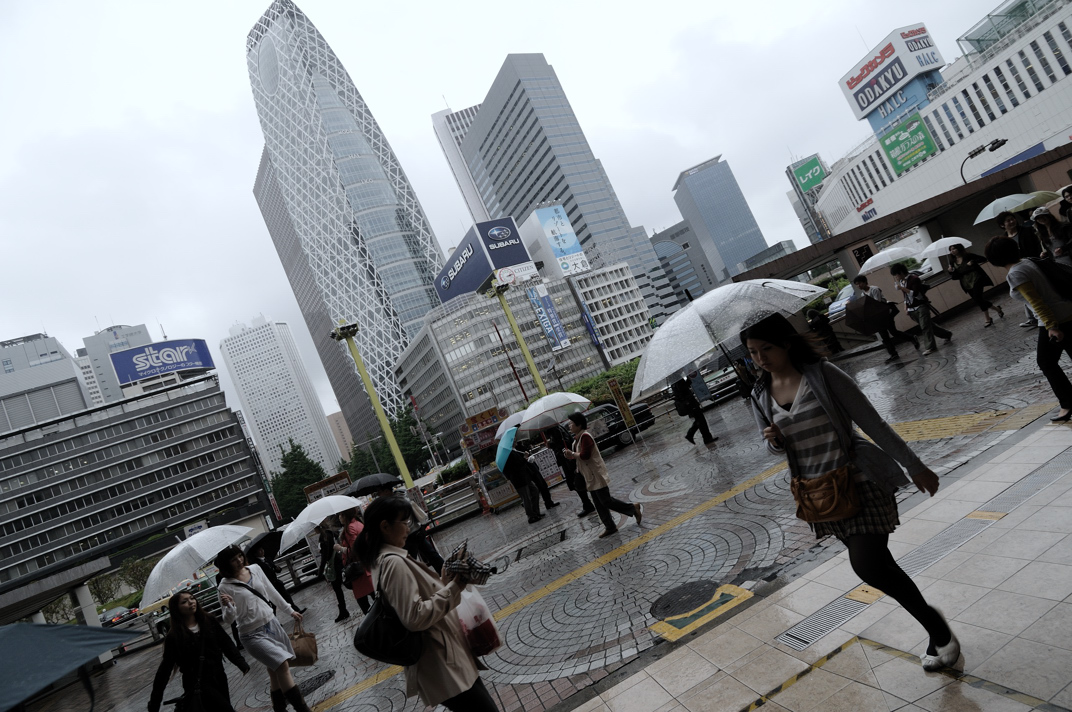
Japan has a very heavy monsoons season. During the monsoon season, it can rain a few inches every day. I went during the beginning of the monsoon season, so the rain wasn’t too bad but it still rained for a few days while we were there. Often it was a steady drizzle with thick humidity. Many people in Japan who have lived in Japan for a long time are used to it, and almost every Japanese person I saw had an umbrella. Many people had very cute, personalized umbrellas. One woman had a polka dotted umbrella with pink and white lace on the edges. A couple cuddled under a wide black umbrella with a white cat outlined along the top.
The most interesting phenomenon I saw was that many shops had umbrella stands that sold umbrellas for as cheap as 500 yen (a little less than $5). These umbrellas were clear, but very wide (pictured below). They weren’t disposable, but they weren’t the best quality. However, for less than $5 they were durable and worked perfectly. I’ve bought $10 umbrellas in America that were so flimsy they broke almost instantly when the wind blew. These cheap, clear umbrellas were very helpful in the rain, and they were wide enough to cover me and my backpack, which was nice because often umbrellas I’ve bought in America are too small for both. These umbrellas are very durable and strong despite being cheap. I bought two because I accidentally left my first one in the hotel room, but the first one I bought broke after a few days.

Asking Directions from a Tourist
In a foreign country, it's always good to know the language of the country you're visiting. If you get lost or need to buy a cab, or even need to ask the time, it's always good to know certain helpful phrases. When I was in Japan, my group and I did a lot of traveling all over. We went to Kyoto prefecture, Tokyo prefecture and also city and Narita (a small city near Tokyo). We walked from about 8 in the morning to 10 at night every day. Every day we covered about 10 miles or so on foot without nearly any seating besides on the subway (if it wasn't busy).
Our teacher wanted us to learn many routes ourselves, so he had us figure out the Tokyo subway system and find our route, and ask many people for directions. He always knew where we were going, but he wanted us to have the experience of getting around ourselves. He also wanted us to be somewhat independent and not blindly follow him around like stray puppies. It's always good to have a map of the area on you when you're in a new country. If you don't have a map, you could easily get lost or not know your route.
It was hilarious, three times when we asked people for directions, they gave us directions completely opposite of the way we were supposed to go. Without our teacher to tell us where we really should go
Friday, February 26, 2016
Japanese Flip Phones
In America, everyone has cell phones. They are great. Often, many Americans have iPhones or other touch screen devices. The most popular phones in America are Apple iPhones, but other competitors such as the Samsung Galaxy are popular as well. Many of these phones are often broken and need to be replaced often (especially the screens). Because of this, many new models are constantly coming out. For example, the iPhone 6s recently came out. There is a conspiracy theory among various conspiracy theorists that these phones are made terribly, and when a new model comes out or the software is updated, the hardware of the old phones can’t handle the updates and perform more slowly, making Americans and other Apple consumers want faster phones (the newer models) more.
In Japan, Apple iPhones are popular and many people have them. However, a more common type of phone is the flip phone. The largest flip phone company in Japan is called Docomo, and it produces hundreds of thousands of new flip phones a year. Some flip phones in Japan can have touch screens, but a key feature (no pun intended) of the keys is that you have to push each key multiple times to get certain characters or letters. The flip phones in Japan are seen as iconic. They are especially popular among teenagers. Japanese teenagers love the fact that other countries don’t use flip phones as a status symbol as much as Japan because it makes them feel unique. All teenagers want to feel unique, and their unique style is what helps them grow to be a mature adult with their own identity.
Harajuku is the fashion capital of Japan. Many people there are cosplaying or showing off their most recent styles and trends. Lots of girls are in kimonos, and many others are showing off their summer yukatas. More often, however, they are showing their Tokyo metropolis-like fashions.


Subscribe to:
Posts (Atom)